Total Ship Solutions
The Total Ship Solution (TSS) From PSM
Is an integrated marine automation platform combining and integrating Turbo SCADA, Tank Gauging, AI-Driven Predictive Maintenance, and ERP functionaly, to enhance vessel operational efficiency and safety, and to reduce life-cycle costs through centralised monitoring and intelligent decision support.
A Total Ship Solution (TSS) to integrate vessel operations of:
• Supervisory Control and Data Acquisition “Turbo SCADA”
• Tank Gauging System (TGS)
• Artificial Intelligence (AI)
• Enterprise Resource Planning (ERP) Systems
Targeting commercial and government fleets, TSS centralises real-time monitoring of propulsion, power generation, tank levels, fire safety, and auxiliary systems via industrial HMI’s located on the bridge and in the engine control room.
The system collects data from various analogue and digital sensors using industry standard protocols like Modbus, Profibus, and CANopen, to deliver full picture of vessel status enabling comprehensive diagnostics and alarm management across engine, generator, propeller, and bilge systems.
By integrating ERP functionality, TSS synchronises operational data with inventory, maintenance scheduling, and financial systems, improving resource allocation and compliance.
AI capabilities leverage historical records and real-time sensor data to predict equipment failures—such as bearing wear or engine overheating.
TSS Turbo SCADA system advanced features:
- Real-time trend analysis
- Automated report generation in PDF or CSV
- System self-diagnostics that detect communication failures, PLC module faults, and sensor anomalies to prevent false alarms
- Client-server architecture enables data sharing across onboard stations and secure remote access via encrypted channels for troubleshooting
- Reducing maintenance downtime
Turbo SCADA system operation levels:
- Main HMI Monitoring
- Serves as the central visualisation and control interface, displaying real-time process diagrams, alarms, and operational parameters for propulsion, auxiliary machinery, tanks, and safety systems.
- Supports dual-redundant touch displays with role-based access control to separate viewing, operational, and engineering functions.
- Remote Monitoring
- Deployed in crew areas to provide simplified status updates and alarm indications via LED indicators and small LCD screens, ensuring rapid crew response.
- Signal Integration
- The Signal Integration control panel aggregates inputs from analogue and digital sensors including temperature, pressure, flow, and level switches, and interfaces with external systems via communication protocols such as Modbus, Profibus, and TCP/IP.
Tank Gauging System
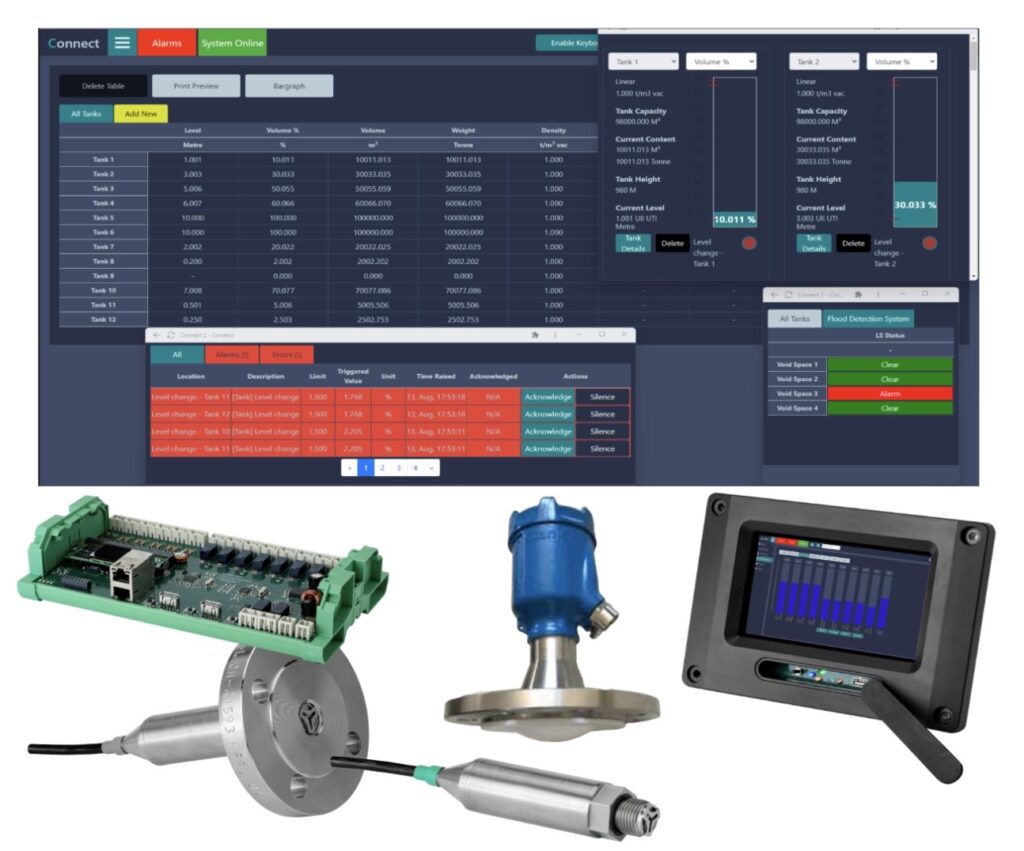
The tank gauging system provides continuous monitoring of fuel, oil, bilge, and ballast tanks using level transmitters and float switches, with data integrated directly into the Turbo SCADA platform.
Fuel and oil tank levels are measured in real time and displayed as in the required engineering units or percentages on HMI screens, enabling precise fuel consumption tracking and early detection of leaks or overflows.
For bilge and service tanks, the system monitors water levels and triggers alarms when thresholds are exceeded, with the capability to automatically activate bilge pumps to prevent flooding or start / stop fuel tank pumps, to ensure vessel stability.
Level data is logged continuously and can be analysed through historical trend graphs, supporting compliance with maritime safety regulations such as MARPOL and SOLAS.
The integration of tank gauging with the central SCADA system eliminates data silos, allowing operators to correlate tank conditions with engine performance and voyage planning, enhancing operational safety and efficiency.
AI Support and Predictive Maintenance System
AI-driven predictive maintenance forecasts engine failures before they occur, leveraging machine learning algorithms trained on real-time and historical sensor data.
The system continuously analyses parameters such as vibration, temperature, pressure, and exhaust gas emissions from engines, generators, pumps, and gearboxes to detect subtle anomalies indicative of impending faults.
For example, slight deviations in bearing temperature or propeller shaft RPM can be flagged as early warnings, enabling proactive maintenance scheduling and minimising unplanned downtime.
Case studies show that AI-powered systems have reduced emergency dry docking by threefold and engine-related downtime by over 20%.
The AI module integrates with the SCADA database, utilising logged data for model training and refinement, and provides actionable alerts to operators via the HMI.
By transforming raw sensor data into predictive insights, it enhances vessel reliability, extends equipment lifespan, and supports compliance with energy efficiency standards such as the IMO’s EEXI.
ERP System Integration
Integrating ERP functionality to bridge operational technology (OT) with enterprise-level business processes, enables seamless data flow between the shipboard SCADA system and shore-based management systems.
Real-time production metrics, maintenance logs, and inventory levels are synchronised with ERP modules for inventory management, work order scheduling, and financial reporting, creating a single source of accurate data across the organisation.
This integration allows for improved resource planning—such as optimising spare parts procurement based on predictive maintenance forecasts—and enhances traceability from order to delivery, critical for quality assurance and regulatory compliance.
By connecting Turbo SCADA with cloud-based ERP systems via APIs or middleware, TSS eliminates manual data entry, reduces human error, and accelerates decision-making for reduced operational costs and improved compliance with international maritime regulations.
TSS – ADVANTAGES
- Advanced Lubrication & Cooling System Management
- Smart Alarm Prioritisation & Intelligent Event Correlation
- Integrated Communication with Shore Operations
- Inventory & Spare Parts Automation
TSS – SELF DIAGNOSTIC
- Diagnostics For Failed Channels in IO Cards
- Diagnostics For Failed Racks in DAQ
- Diagnostics For Failed HMI
- Diagnostics For Failed Communication
- All diagnostic status levels are reported to Turbo SCADA in a standalone page